Frequent travelers like me can become surprisingly obsessed with the luggage they buy. The carry-on rollerboard, in particular, is our constant companion, traveling alongside us everywhere we go, sometimes tens of thousands of miles from home. It carries and protects our necessities and is rarely out of our site. Becoming separated could ruin our trip. We want a suitcase that’s easy to pack, fits more than it’s designed to hold, pulls smoothly and can take plenty of abuse.
Different travelers have different solutions. Some, like my friend Joe Brancatelli, editor of the travel newsletter JoeSentMe, buys the least costly but decent luggage he can find and replaces it as needed without hesitation. He has a good point, because serviceable 22-inch rollerback ranges in price from about $100 up to $1500 or more.
But many travelers like myself go for the technically advanced name brand products from companies like Tumi and Briggs and Riley. They are often made from more expensive materials such as ballistic nylon or polycarbonate, have clever features such as being compressible or using special wheels from Japan.
Over my fifty years of traveling I’ve tried most of them. I migrated from American Tourister to Hartmann to Victorinox to Tumi to Briggs and RIley to Away. I’ve eyed aluminum luggage from Rimowa, one fo the most costly brnads, and occasionaly purchased a Samsonite piece only sold in Asia and Europe. And I’ve noticed that pilots and flight attendants are partial to TravelPro, the company that has made a special effort to market their products to airline employees. That’s one brand I’ve not bought.
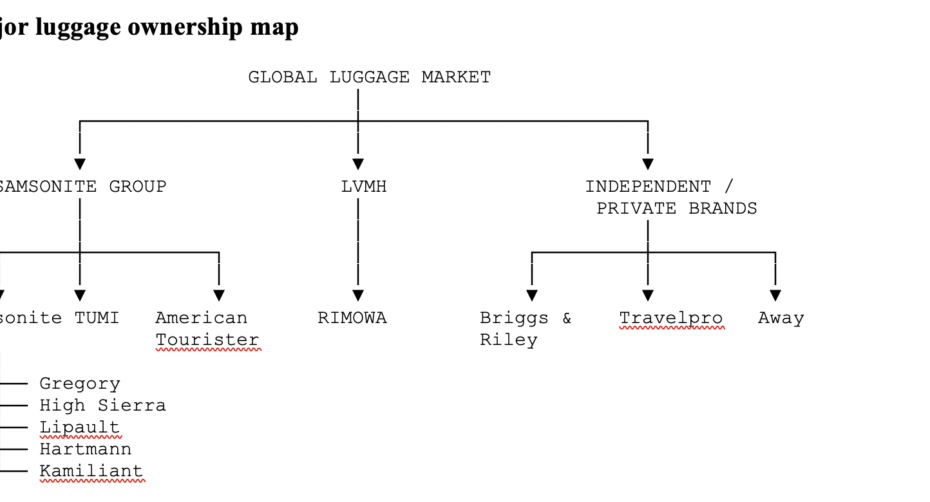
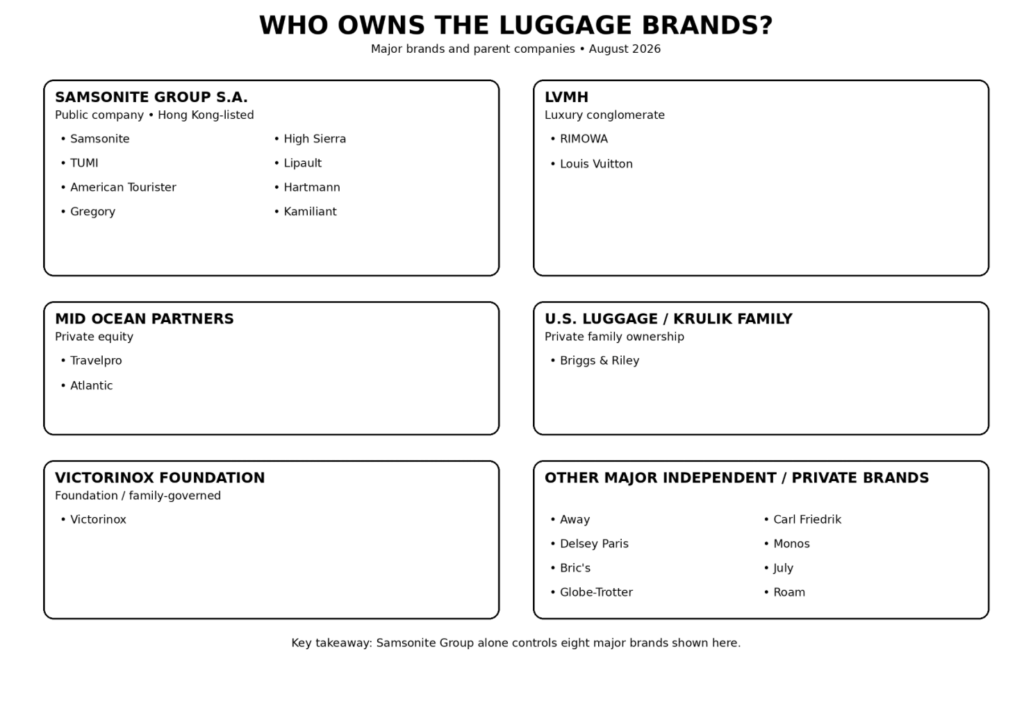
With the help of ChatGPT, I put together some information about how the most popular luggage brands are connected through corporate consolidation, while others have remained a family business or privately owned.
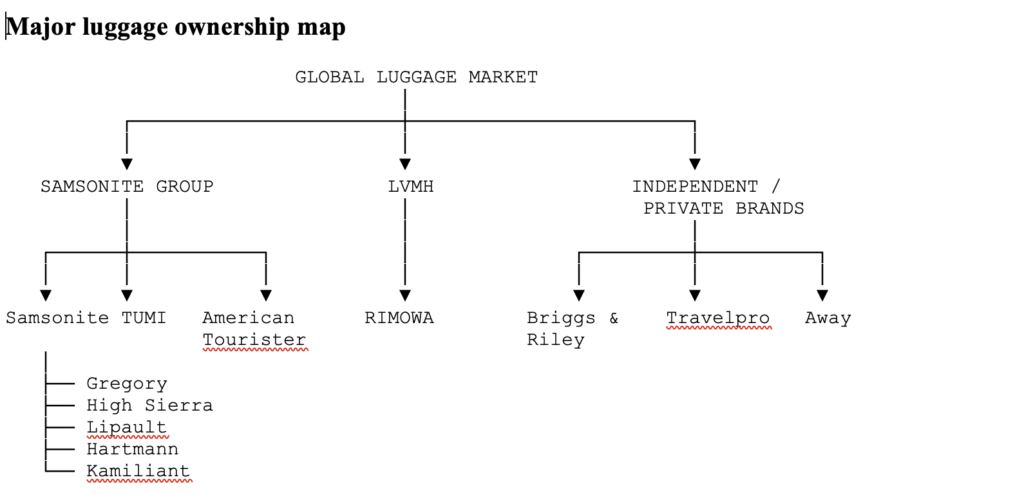
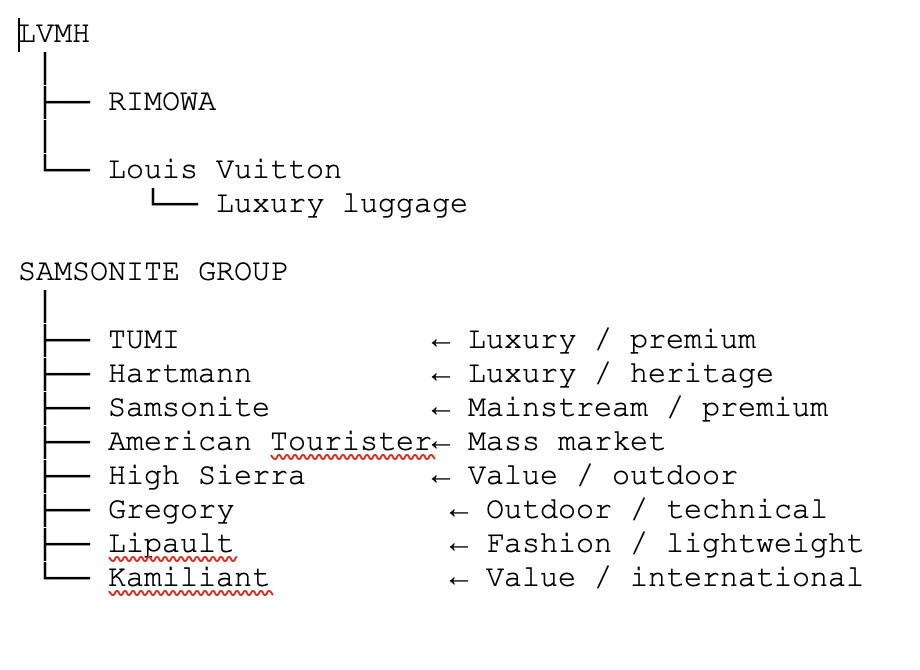
A broader picture including luxury brands
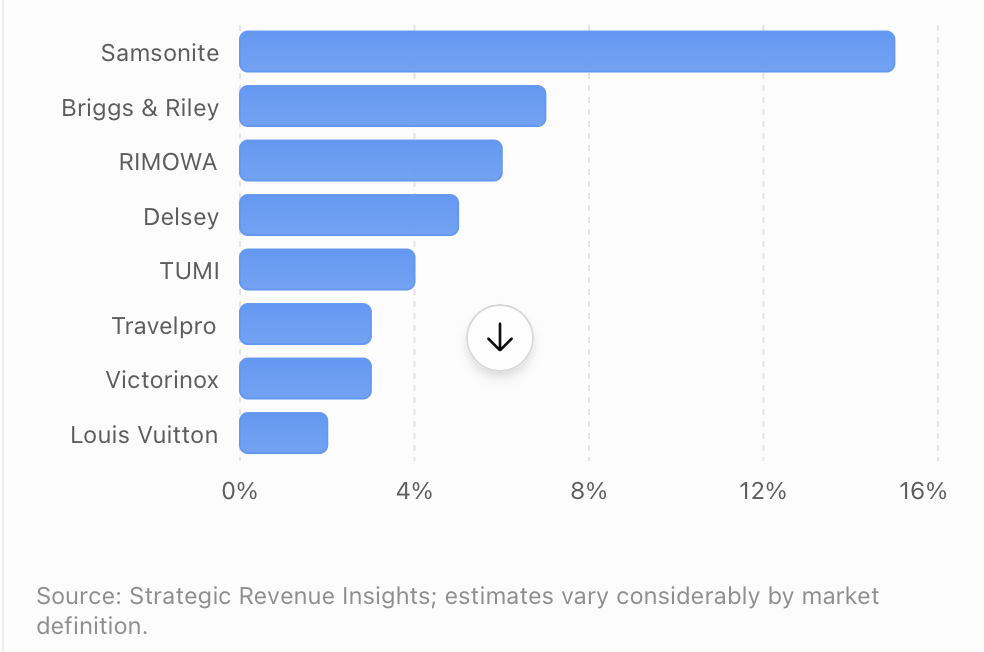
It’s hard to determine the relative market shares of these companies because much of the data is private, but here is one estimate:
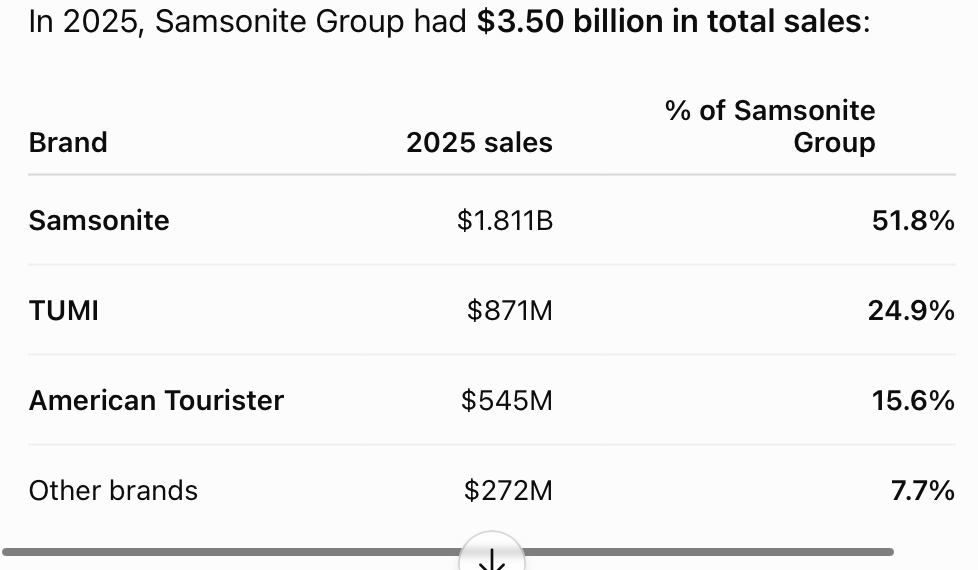
Among Samsonite owned brands we have this information:
Finally, here’s how some of these brands evolved:
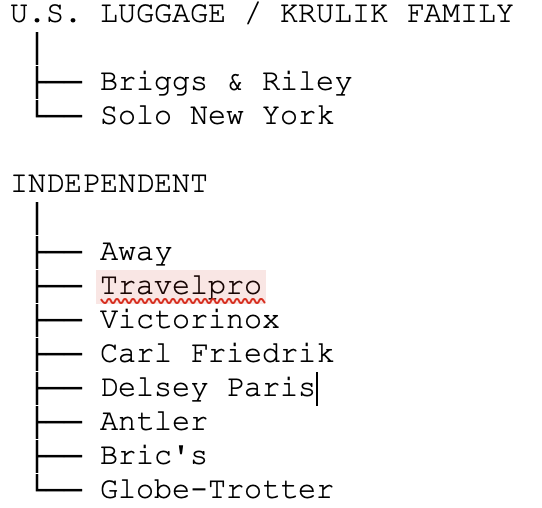
Briggs & Riley and the Krulik family
The company behind Briggs & Riley is United States Luggage Company (U.S. Luggage), a privately owned business led by Richard Krulik, who is CEO. U.S. Luggage describes itself as a third-generation family-owned company. It currently operates two principal brands: Briggs & Riley and Solo New York.
The family’s story goes back to Richard Krulik’s grandfather, Hans Ax, who was a leather-goods businessman in Vienna. According to a recently published account based on family documents, Ax fled Austria after the Nazi annexation in 1938 and eventually came to America in 1940. He subsequently established London Leather, beginning the family’s American luggage and leather-goods business.
Richard Krulik joined the family business in the late 1980s after earning an MBA from Columbia Business School. He eventually became CEO and, in August 2000, acquired Briggs & Riley Travelware. Briggs & Riley itself was founded in 1993, before Krulik bought it. It has become a premium luggage brand positioned around durability, engineering, and service rather than fashion.
The company is known for its lifetime guarantee. The company’s guarantee covers repairs for the life of the bag and famously does not exclude damage caused by airlines. That is an unusual guarantee in an industry where baggage damage is a normal part of flying.
The company has also developed a reputation for engineering innovations, including its outside handle, which places the telescoping handle mechanism outside on the back of the suitcase instead of inside, and its CX compression-expansion system, which allows the suitcase to expand and then compress back to its original size.
Tumi
TUMI was founded in 1975 by Charlie Clifford, an American who had served as a Peace Corps volunteer in Peru. After his time in South America, Clifford began importing leather bags from the region. The name TUMI came from a Peruvian ceremonial object he encountered there.
In 1983 TUMI introduced its now-famous black ballistic-nylon bags and business cases. That was an important innovation from the leather luggage that dominated the premium market at the time.
The material had been developed for extremely demanding applications and was extraordinarily tough. TUMI combined it with a very functional aesthetic: black-on-black, minimal decoration, lots of compartments, clever hardware and an emphasis on durability. TUMI says the introduction of ballistic nylon in the 1980s is what “catapulted” the company into its leadership position.
TUMI was particularly successful because it understood the business traveler beginning in the 1980s and ’90s when the laptop was becoming an essential business tool. TUMI developed products around computer cases, garment bags, briefcases and eventually wheeled luggage. It also developed specialized computer protection and its TUMI Tracer identification/recovery system. By the late 1990s, TUMI had become something of a status symbol for frequent business travelers.
The company eventually attracted a private-equity investment and was acquired by Doughty Hanson in 2004. TUMI later went public on the New York Stock Exchange in 2012. Four years later Samsonite announced that it would acquire TUMI for $26.75 per share, valuing the company at approximately $1.8 billion.
Samsonite
Samsonite’s roots go back to 1910 in Denver, when Jesse Shwayder founded the Shwayder Trunk Manufacturing Company with his brothers. The company initially made heavy wooden trunks at a time when travel meant railroads and ocean liners.
In 1941, the company introduced a suitcase called Samsonite Streamlite. The name was chosen to evoke the biblical Samson and the qualities of strength and durability. In 1965, the corporate name was changed to Samsonite Corporation.
In the 1950s, Samsonite moved away from heavy wooden construction toward lighter materials, including magnesium and ABS plastic. In 1974, it introduced one of its most important innovations: a suitcase with wheels. Later came the Oyster, an injection-molded hard-shell case, and eventually four-wheel spinner luggage.
When I worked at Polaroid we developed a portable identification camera used by DMVs to create drivers licenses. We wanted to encase the camera in rugged portable unit, and went to Samsonite to build a special enclosure that was based on their hard-shell suitcases. At that time all of their manufacturing was done in Denver, CO.
In 1973, Samsonite Corporation was sold to Beatrice Foods, ending the Shwayder family’s ownership. That began a long period in which Samsonite passed through different corporate owners and financial restructurings. In 2011 Samsonite completed an IPO on the Hong Kong Stock Exchange and continues to be publicly traded there.
For much of its history, Samsonite was primarily a single luggage brand. In 1993 Samsonite acquired American Tourister, giving it a second major luggage brand with a more affordable, mass-market position. In 2012 Samsonite acquired High Sierra and Hartmann and in 2016 bought TUMI.
For 2025, Samsonite Group reported approximately $3.50 billion in net sales, about 11,500 full-time-equivalent employees, more than 1,150 company-operated stores, eight distribution centers and operations in more than 40 countries.
Relative sales are shown below. Note that Tumi sales are now about half of Samsonite-branded luggage.
| Brand | Share of 2025 Samsonite Group sales |
|---|---|
| Samsonite | 51.8% |
| TUMI | 24.9% |
| American Tourister | 15.6% |
| Other brands | 7.7% |
Victorinox
Victorinox dates to 1884, when Karl Elsener opened a cutlery workshop in Ibach, Switzerland. In 1891, he began supplying knives to the Swiss Army, and in 1897 he patented the product that eventually became the famous Swiss Army Knife. The company adopted the Victorinox name in 1921, combining “Victoria”—the name of Elsener’s mother—with “inox,” referring to stainless steel.
For most of its history, Victorinox was a knife company. But the family gradually realized that the Swiss Army Knife represented something much bigger than a knife: it represented preparedness, functionality, durability and Swiss engineering. That became the foundation for expanding the brand.
In 1999 Victorinox entered the travel-gear market through an American company, TRG Group, which licensed the Victorinox name for luggage, backpacks and small leather goods. They devekoped and sold travel products under the Victorinox brand.
In 2014, Victorinox bought the travel product business back from TRG and established Victorinox Travel Gear AG as its own business unit, concluding that luggage was too important to its brand to leave in someone else’s hands. Victorinox isn’t a public company and describes itself as a family-values company operating in more than 120 countries.
TravelPro
In 1987, Robert “Bob” Plath, a Northwest Airlines 747 captain, was frustrated with the luggage he had to drag through airports. He designed a suitcase that stood upright, had two wheels at the bottom and a retractable handle. He called it the Rollaboard.
Plath initially made the bags for himself and his fellow pilots and flight attendants. They became an instant hit with crews. Passengers began noticing airline employees effortlessly rolling their luggage through airports and asking where they could buy one. Plath eventually left Northwest and devoted himself full-time to Travelpro. By the early 1990s, the company was selling commercially.
Travelpro built its identity around a very simple proposition: If it’s good enough for someone who flies for a living, it’s good enough for you. That remains central to the company today. Travelpro says its products are used by more than 220,000 aviation professionals and that its luggage is used by crews at more than 30 airlines.
Travelpro is no longer owned by Bob Plath. In 2016, MidOcean Partners, a private-equity firm, acquired the assets of Travelpro International and Holiday Group. The resulting Travelpro Group includes the Travelpro and Atlantic brands in the U.S., along with Holiday Group’s Canadian luggage and travel-accessories business. Travelpro is privately held through private equity.
Hartmann
Hartmann was founded in 1877 in Milwaukee, Wisconsin, by Joseph S. Hartmann, a Bavarian-born trunk maker. The company began making trunks for an era when travel was still largely by train and ship. Its original promise was essentially luxury craftsmanship: Hartmann said its luggage should be “a symbol of excellence.”
By the early 20th century, Hartmann had become an established American luggage maker. A Hartmann trunk won first prize at the 1908 California Exposition in Sacramento, and by 1925 the company says it had roughly half a million cases in use around the world.
Babe Ruth traveled with a Hartmann wardrobe trunk in the 1920s. James Bond carried a Hartmann Skymate suitcase in Ian Fleming’s Live and Let Die. And President Lyndon B. Johnson used a Hartmann Skymate on his travels aboard Air Force One.
Hartmann went through several ownership changes. It was acquired by Brown-Forman in 1983, and Brown-Forman subsequently sold it to private-equity firm. By then, Hartmann had tremendous heritage but was a relatively small business. In 2011, it generated only about $23 million in sales.
In August 2012, Samsonite acquired Hartmann for about $35 million. Samsonite had previously tried to move upscale, but consumers still associated the Samsonite name with mainstream luggage. Hartmann gave Samsonite something it couldn’t manufacture overnight: a luxury brand.
One of Hartmann’s most famous products was the all-leather Hartmann briefcase covered in a rich medium colored tan cowhide with leather flaps covering the brushed gold colored hardware.