We no longer see the swarm of major new gadgets that we saw earlier in this decade. Instead we’re seeing refinements, improvements, and more miniaturization. I recently looked back on some of the gadgets that I purchased this year and like enough to recommend.
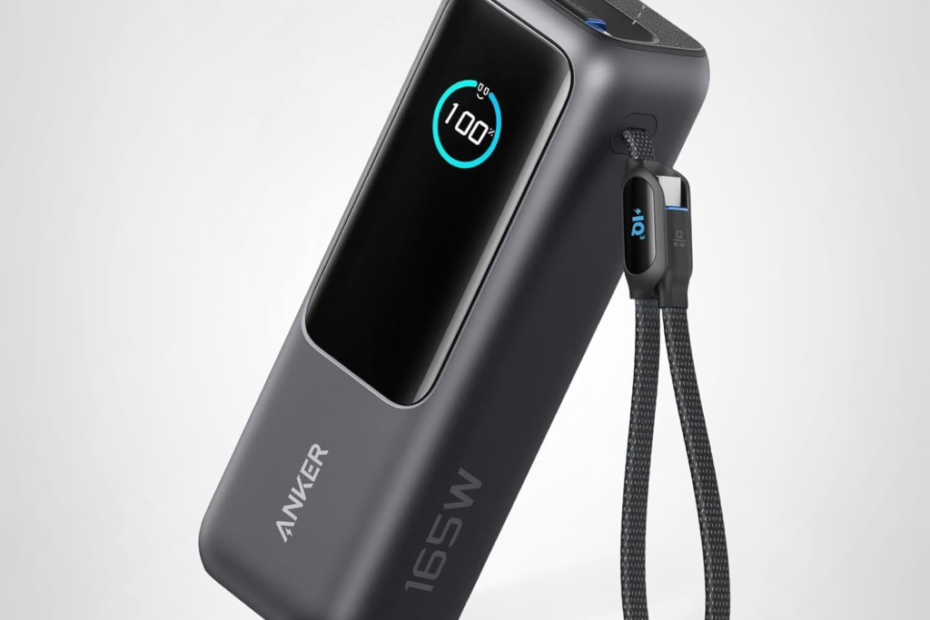
Anker Laptop Power Bank
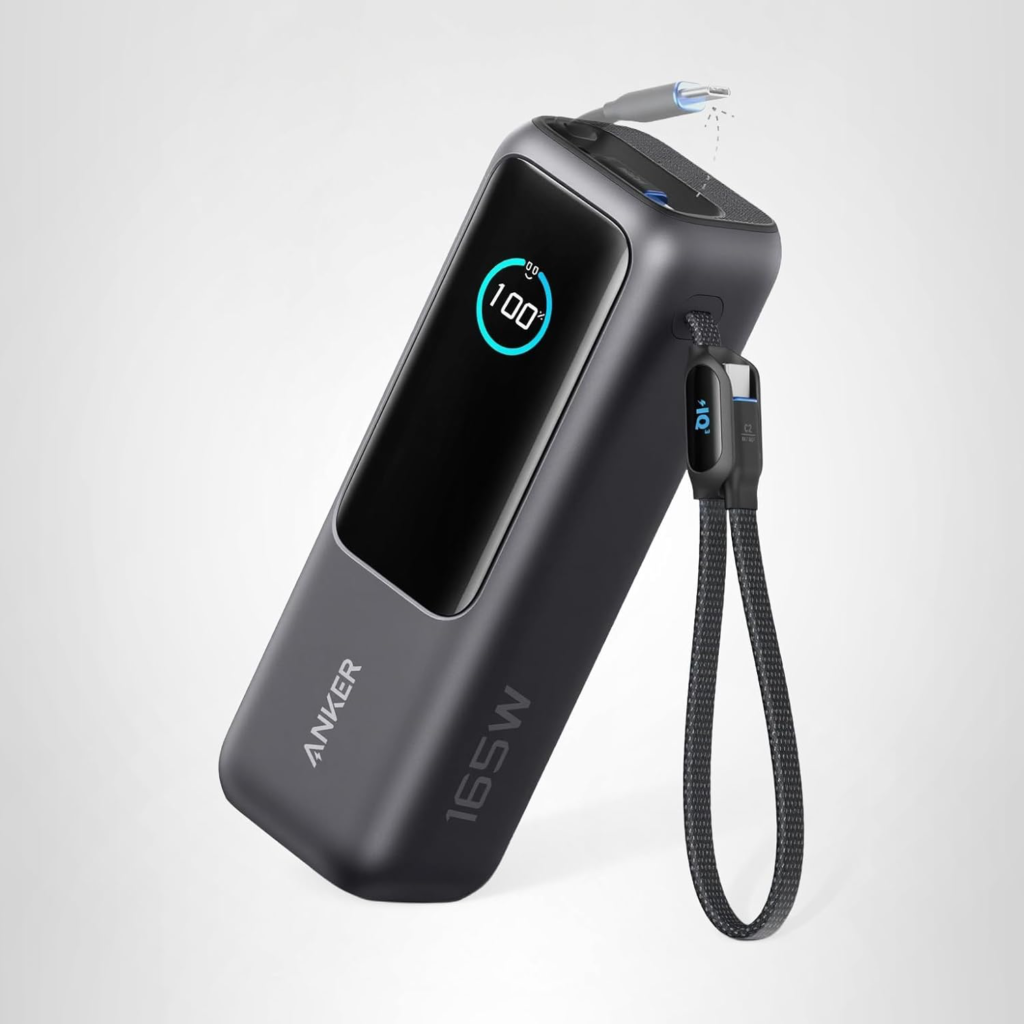
Battery backups have dropped in price and suppliers have multiplied. Most of them are slabs containing with several battery cells to provide anywhere from 5000 to 25,000 mAh, a measure of their capacity. (You can compare the number to an iPhone battery of about 4000 mAh and figure out that a 5000mAh will be one filling of that battery, taking into account some losses that occur.
This is a 25,000mAh portable charger has a multidue of ports for charging several devices at once, incuding a notebook computer. What’s unique is it’s 100 watt capacity, the built in cables, and the display. It’s one of the largest capacity batteries that is flight-approved and it is an ideal travel companion. You can use it on a plane and never worry about relying on the very slow charging ports at your seat. In your hotel, forget about looking for an outlet. This can sit on your nightable and keep everything within reach while charging. A useful display tells you how much each device is using while charging. And it itself charges very quickly. It lists for $120, but is often on sale at Anker, Amazon and Costco.com for about $85.
ThermoWorks RFX Wireless Probe Starter Kit
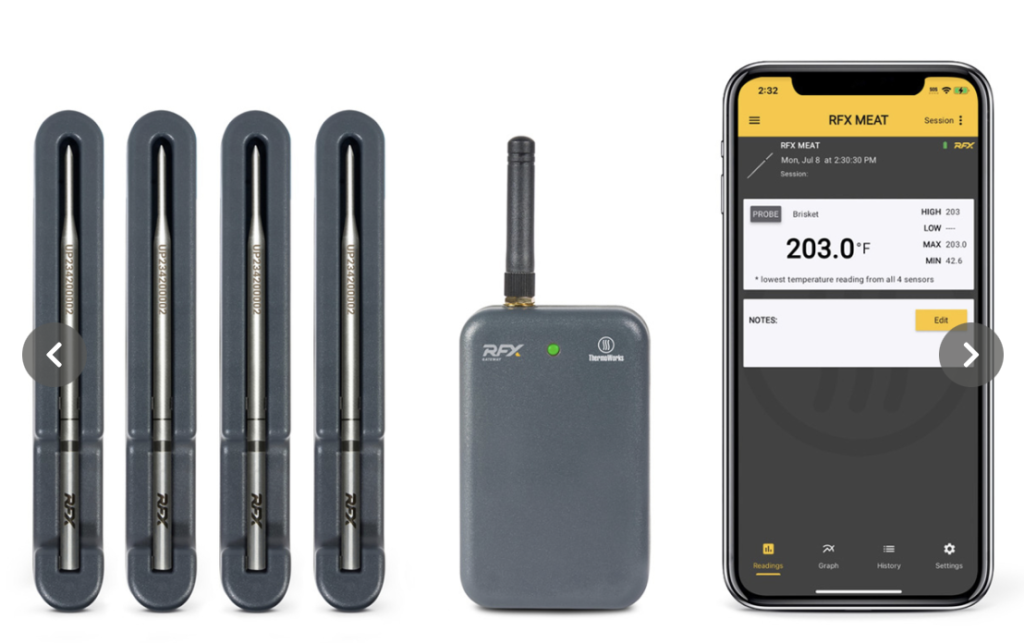
A few years ago the first wireless temperature probe was introduced for $100 for remotely measuring the temperature of meat being cooked on a BBQ. No wires were required, just an app or a module that wirekessky communicated with the probe that was about the size of a thin pencil. That company, Meater, was bought by Traeger and a proliferation of new products, both copycats, and much improved models emerged from companies such as Fireboard, Combustion and Thermoworks. There are also numerous knockoffs from China proliferating Amazon. The advantage of the design is to eliminate the wires running from a temperature probe to the control box with the temperature display and to be able to measure the temperature of meat sppinning on a rotisserie.
I’ve tried most of the top units when BBQing and smoking on my charcoal and pellet grills. Issues with them include loss of wireless signal through the grill, how far they will send their signal, the ability to withstand sudden high temepratures, and the software used to monitor the temperature. I’ve found the best of the bunch, based on reliability, value, and performance to be the ThermoWorks RFX model. It uses a more robust communications band and is much more affordable when buying multiple probes, about $50-$60 each. ThermoWorks also often runs frequent sales.
Among the other top brands, Fireboard (who also makes some of the best wired devices) has a clever design for charging and has some of the best software, but needs a $200 controller. Combustion makes a thermometer with eight built-in sensors that will predict the finishing time quite accurately. Unfortunately, the probes from these companies cost $150 or more.
Asus 27-inch ProArt Monitor

Something better than an iMac – When my wife’s 7-year old iMac slowed to a crawl after the most recent upgrade to Sonoma, we called Apple and were told her machine was probably incapable of running it. Yes, it would have been nice to know that before. Faced with a replacement cost of nearly $2000 for a new iMac, we decided to add a monitor to her M1 iPad Air. After lots of research I bought the $200 ASUS ProArt Display PA278QV 27” Monitor to connect to the MacBook. I initially looked at this as acompromise but we quickly realized how much better it was than another iMac. The monitor was larger, sharper and more vibrant, and the monitor stand provided much more flexibility and adjustability than an iMac: the monitor could be raised and lowered and tilted to fit her perfectly. Even if she didn’t have the MacBook, it would have made sense to buy one for less than $1000. The monitor also provides plenty of ports and connections.
For Window users, you have another option. Look at some of the new mini PCs that cost as little as $200. I have no experience with them and was unaware such a category existed until informed by a friend.
Eero 7 Pro
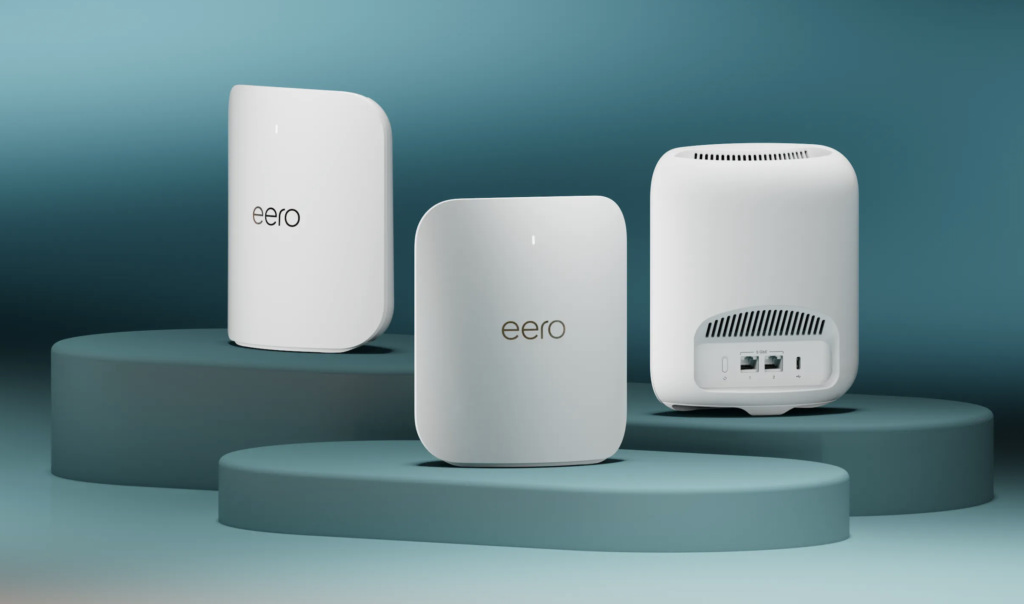
The Eero Pro 7 is Eero’s latest home mesh WiFi system for homes with a multi-gig internet, meaning 1GB or more service, something now becoming available from more providers. I have Ting fiber that recently increased the speed from 1GB to 2GB without any change in my monthly charge. My existing Eero 6+ was unable to deliver more than 50 to 100 MB to many parts of my home. In theory that should be enough, because streaming video can work with as little as 10Mbps, one-hundreth of 1GB.
But that can be misleading. The 1GB is quickly attenuated through walls and with distance from the main router and we’re now running dozens of simultaneous connections without being aware of them. We could be streaming Netflix on multiple TVs while another person is on a Zoom call. Simultaneously, our phones are backing up photos, our watches are updating its software, laptops are syncing files to the cloud, and security cameras are constantly uploading video. Each of these activities may be small on its own, but together they add up quickly. Since we are paying for high speed internet, why not take advantage of it.
I’ve always been hesitant to disturb something as complex as a router when it’s working ok, but I need not have worried. We’ve come a long way in updating our router, especially when we maintain the same brand. Using the Eero app, I simply replaced one unit at a time following the directions. Total time to replace three mesh units was less ten minutes. No other devices needed to be reconnected or registered since the new router uses the same name and password as the old. A kit of three Eero 7 Plus units cost about $550 on sale, sufficient for most homes up to 3000 square feet.
Oura RIng 4
The Oura Ring 4 improves upon previous models, making it even more subtle and unobtrusive. This past year with an expanded distribution strategy and more effective marketing, it’s left the competition way behind. It’s thinner, lighter, and more refined than previous versions, with a smooth interior that makes it comfortable enough to wear 24/7, including during sleep. The updated sensor array sits flush inside the band, improving accuracy without making the ring feel bulky or awkward on the finger. Once it’s on, it all but disappears. It quietly tracks sleep, recovery, heart rate, and temperature trends without buzzing, vibrating, or demanding attention. Battery life stretches to about 5 or 6 days. I check my sleep score and readiness score each morning and read its advice. I don’t mind paying the small monthly subscription of $5.99 because of how much effort the company has made to bring more value into the app and insight into the measurements. For people who want serious health insights without wearing a watch, the Oura Ring 4 remains in a class of its own. From $349 direct as well as many retailers including Costco.